Showing posts with label teaching. Show all posts

Thursday, May 9, 2013

First Roots in the Ground at Siyasiya, Salima

Farmers were busy in their irrigated gardens the past three weeks, putting to practice what they learned during the initial trainings in April. At Salima, the St. Barnabas irrigation club transplanted tomato seedlings into the first section of their garden.

Though they said they had some challenges at first, the irrigation process has not been difficult for them. They were excited to share with us their plans for expansion.


Saturday, April 27, 2013

Brick water tank at Katsumwa

On Thursday we joined with farmers at Katsumwa to lay the brick wall on the slab we poured back in March. The farmers put a lot of work into the project and we really appreciate that. The tank will be approximately 15,000 liters capacity when finished later next week.


Tuesday, April 16, 2013

Getting Ready For Growth

The Mziza Farming Club is getting into irrigation as early as possible this season. On Monday this week, we delivered farm inputs which the farmers accessed through a revolving fund for input loans.

In order to access the loan, a farmer was required to participate in irrigation training and plant at least two season under the new irrigation techniques. Farmers who proved that they could be successful irrigation farmers could then apply to receive inputs to expand the size of their irrigated gardens.

Each member will pay back the loan over two consecutive planting cycles this season. In this way, the loss of capital incurred by paying back the loan is mitigated by the extra income of the second planting. In other words, with two planting cycles it is easier to balance the crop yield between: 1) paying back the loan, 2) eating a balanced diet at home, and 3) using income for other purposes (e.g. paying school fees).


Saturday, March 2, 2013

Local Design Windmill

On the return journey of a recent field trip to irrigation sites in the Malawian lakeshore district Salima, we practically stumbled upon a local windmill. Tucked behind an acacia grove, so invisible to the many cyclists and motorists passing by, a recent high school graduate had been busy making his dream machine: a windmill generator/water pump.
He had heard we passed by on our way to the field and waited by the roadside four hours until we returned. Before we could get back on the tarmac and drive away oblivious to his invention, he flagged us down and directed us to his home and the 30' tower made from eucalyptus globulus (blue gum) poles.
While the unit did not generate electricity yet, he was preparing to mount a bicycle dynamo to the wheel. We gave him some pointers to help him understand what was happening. He could really understand the kind of power he was looking for and how his design might not work.
Before leaving we gave the best encouragement we could, don't give up, etc., (knowing that this kid probably didn't need any more encouragement than his own ambition). In the car again, we discussed what we could do to help. We came up with a few designs we could build in the workshop and bring back to show him next month. Of course we hope he will also have some improvements by then.

These gems are found throughout the world if only we could find them all!

Composting round 2


Even as a club, making a heap of compost and manure like this is tiring, especially during nthawi ya njala (that is, time of hunger: the colloquial name for the months of January-March). Caloric intake is down, but so are traditional work loads; cultivation is finished, harvesting is pending, and there's little to do on the farms, traditionally. But modern farming, sustainable farming, is a year round endeavor.
The farmers get tired but just when they seem to be giving up, we start talking about what this pile of animal droppings is worth in fertilizer equivalent. First we ask the farmer's what they would charge for this work if they were hired piece workers on someone's farm. The job usually ticks in at about K4,000-K5,000 kwacha. Then we explain that this heap of manure will yield roughly 1 metric ton of compost, enough to supply the nutrients required to grow one quarter acre of corn. Corn, as we all know, requires 200kg of inorganic fertilizer per acre, or 50kg per quarter acre, which costs about K15,000. Thus, the fertilizer equivalent of the compost costs three times more than they would charge for the labour to prepare the compost.


Of course, if you do it wrong, this compost could have a low nutrient content or take ages to decompose into a usable substance. No one said it didn't take some skill. But it is worth the effort, and the farmers tend to pick up their feet a bit higher once they can quantify the fruits of their labour.
So far we have seen some very good work from farmers and we look forward to seeing how far they take the skills when we are not around to watch each step.

Tuesday, February 12, 2013

Mzindo Irrigation

It had just stopped raining in Mzindo families run to the village headman house to hold a meeting with him. The ten families remain standing waiting for traditional leader to come out. He comes out, and finds people with clothes dripping. One representative tells the chief about the irrigation farming. The farmers did not know that AWP had already met him to discuss irrigation farming in the area.
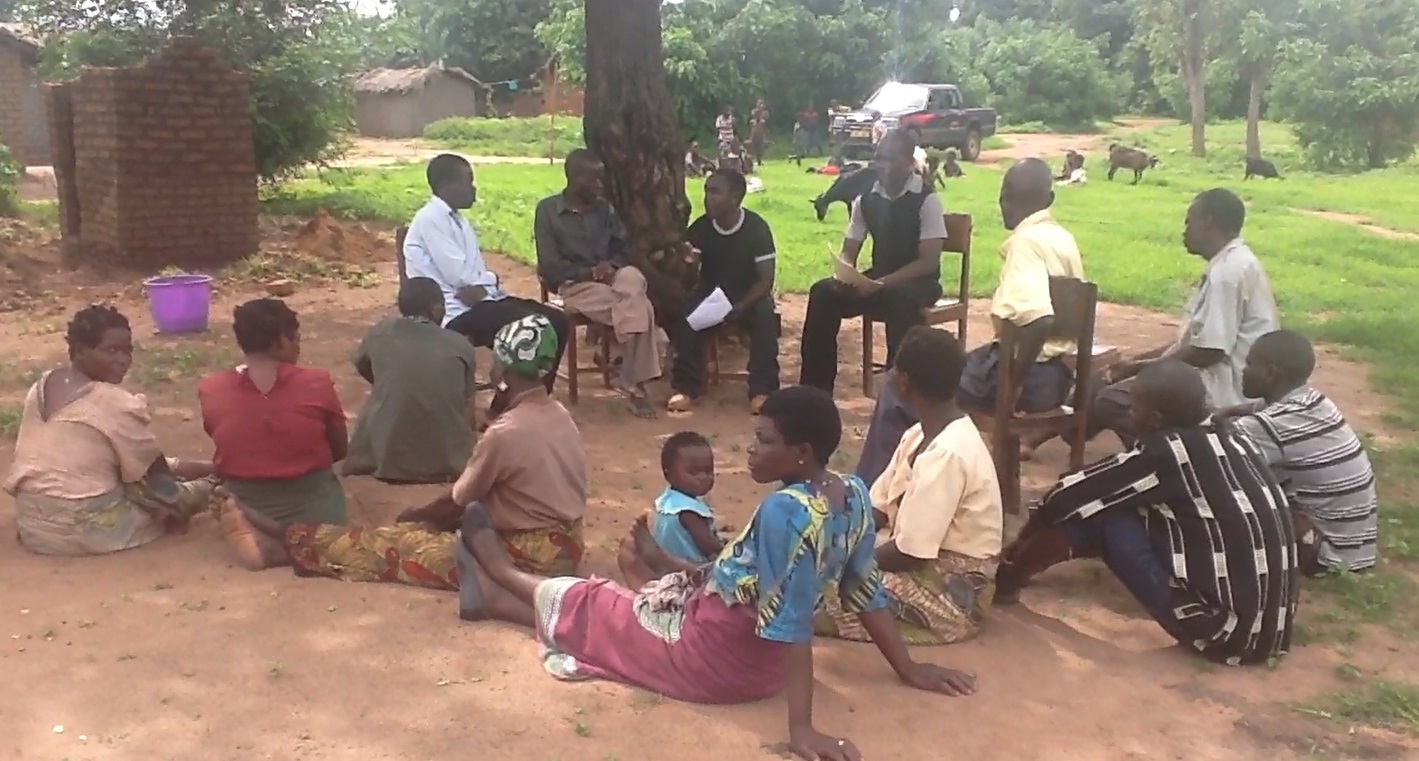
Later that day, AWP starts off on the 30 km drive to Mzindo village to hold the first meeting with farmers interested to participate in irrigation farming. AWP finds farmers sitting around a big tree with a big canopy that provides good shade to children, mothers, fathers and the aged. During the day, most people would converge around these trees to relax after working in the crop fields; play Bawo; listen to cases; attend village meetings; watch traditional dances like gule wamkulu and any other traditional activity.
This day, only adults sit around to hear what AWP has brought to the village. Children play in the tall grass nearby. The meeting begins with introductions and finishes with AWP telling farmers about sustainable irrigation farming and the water pumps that would help them to have improved crop yield each irrigation season. AWP asks the farmers for their commitment to an irrigation project in the area. This sends farmers into hand clapping and ululations.
One farmer rises up and tells AWP how they have had problems using watering cans to irrigate the crops; the activity of drawing water alone is tiresome as compared to the irrigation technology they saw in Mziza village, not far from their village. This farmer finishes by saying the introduction of hand cranked and pedal pumps for irrigation farming will help them to harvest more food in a year. The farmers want to be the beginners in learning the new concept of farming.

The meeting ends with a visit to a new site where the village headman has offered land for establishing an irrigation garden for other farmers within and the neighboring villages. 

Friday, February 1, 2013

Katsumwa Irrigation Project

The Katsumwa Irrigation Project is now under way, in partnership with Good Neighbours International.

There are 20 farmers in the irrigation club. All of them will be fully trained this year. Five of them, the lead farmers in the group, will be farming a 1-2 acre garden using AWP pedal pumps and a brick water reservoir. Next year those farmers should have raised the money and gathered the resources to implement irrigation gardens on their land, and each season a new group of five will be given the chance to use the club's demo garden for experience and the chance to raise their own funds.

The abandoned primary school makes a good classroom for our farmers:

Farmers gather in the classroom:

Participation yields a user friendly calendar for February: 

Fly on the Wall

If you were a fly on the wall at the AWP office today, you would be the fly most equipped to provide high-impact irrigation training in probably the whole of Malawi, even in all of Africa. Maybe you'd be the best six legged irrigation trainer in the WORLD!
Ok, not many irrigation experts to compare in the insect family, but if you were a human on the wall at AWP (get off the wall and have chair), I hope you and the rest of the staff present today would be ready to deliver some outstanding training sessions to farmers in the field.

Teaching a group of adults whose ages range over 40 years, who may or may not be able to read, who usually have heavy burdens put on hold outside the classroom, teaching such a group is no easy task. And you just try for ten minutes to focus with an empty stomach... no, didn't think so.

After a few hours spent discussing how our training programme should adapt to the particular challenges we face in the field, we came up with a short protocol to guide us. 
  1. Adults can only be expected to learn 5 simple things a day. If we selfishly take all those things for irrigation, we still should only expect 5 learned outcomes. Some things aren't so simple, so fewer expected outcomes is better.
  2. Good teachers deliver their outcomes over multiple routes; we should bring the learned outcomes through a variety of components: verbal/aural, visual (photographic/text), tactile, and participatory. These should be highly memorable and form memory indicators or associations.
  3. The visual and tactile elements should be left in the hands of the trainees to review/repeat in the future.
  4. We should hit the key memory indicators once more at the end of the training session.

Monday, January 28, 2013

January Update

Hello Friends of AWP!

January has been spent kicking off a series of new projects in Malawi. As such, we need to kick off the Blog for the year too!

First, we want to thank everyone who has been reading the blog. I know that people read the blog for different reasons, and providing a variety of content is one of our goals this year. We want to showcase our work, provide technical details for those who land on this blog in search of pump/tech designs, and raise awareness for food security and other local issues.

We have spent this month meeting the farmers who will be in training this year.

At Nathenje: a 15 member support group organized by National Association for People living with HIV and AIDS in Malawi (NAPHAM).

At Mzindo: 5 families organized under AWP through outreach conducted by the Mziza Farming Club.

Still to come: Katsumwa, Siyasiya and Kanyelele.

Sunday, September 2, 2012

The "Aha! moment"

In 7th grade I had a math teacher who said that rather than teach for the standardized tests, she teaches for the "Aha! moment". She was a good teacher, and we all learned a lot from her, about geometry and algebra, but the teaching philosophy most importantly. The "Aha! moment" is the moment when a person realizes they know what they are doing. In other words, the teacher may give us information, and we (lifelong students) may possess that information, but what is important is that we know that we know it.

And what signifies (to the teacher) that we have this knowledge? Some people exclaim "Aha!", but the surest sign is when the student corrects a teacher's mistake. It takes a good teacher to realize that being corrected by students is a good thing.

Some recent field days with farmers at Mziza have driven this point home.

What is causing the low water flow out of this pump?


AWP hypothesis: low rpm caused by bad gearing
Farmer's hypothesis: broken or bent washers caused by slack in the rope
Answer: improperly sized washers used to replace broken washers

One to the student... Of course, if we teachers had followed our own method, we should have come to the same hypothesis as the farmer.

What is causing low germination rate in this maize field?


AWP hypothesis: insufficient water
Farmer's hypothesis: mice
Answer: probably mice, as the problem ceased after burning out the mice holes.

Two lessons the teacher should take away from this:
1) follow your own method, and start with the simplest analysis.
2) local wisdom is exceptionally wise in its own locale; heed its advice.


Farmers are getting irrigation now. There is an intuitive understanding of how to use the water pumps, how to design and cultivate the garden, and how to plan their farming activities.


The next step, we hope, is that those who have excelled may start teaching others, first time irrigators and those who are struggling at some point in the process.