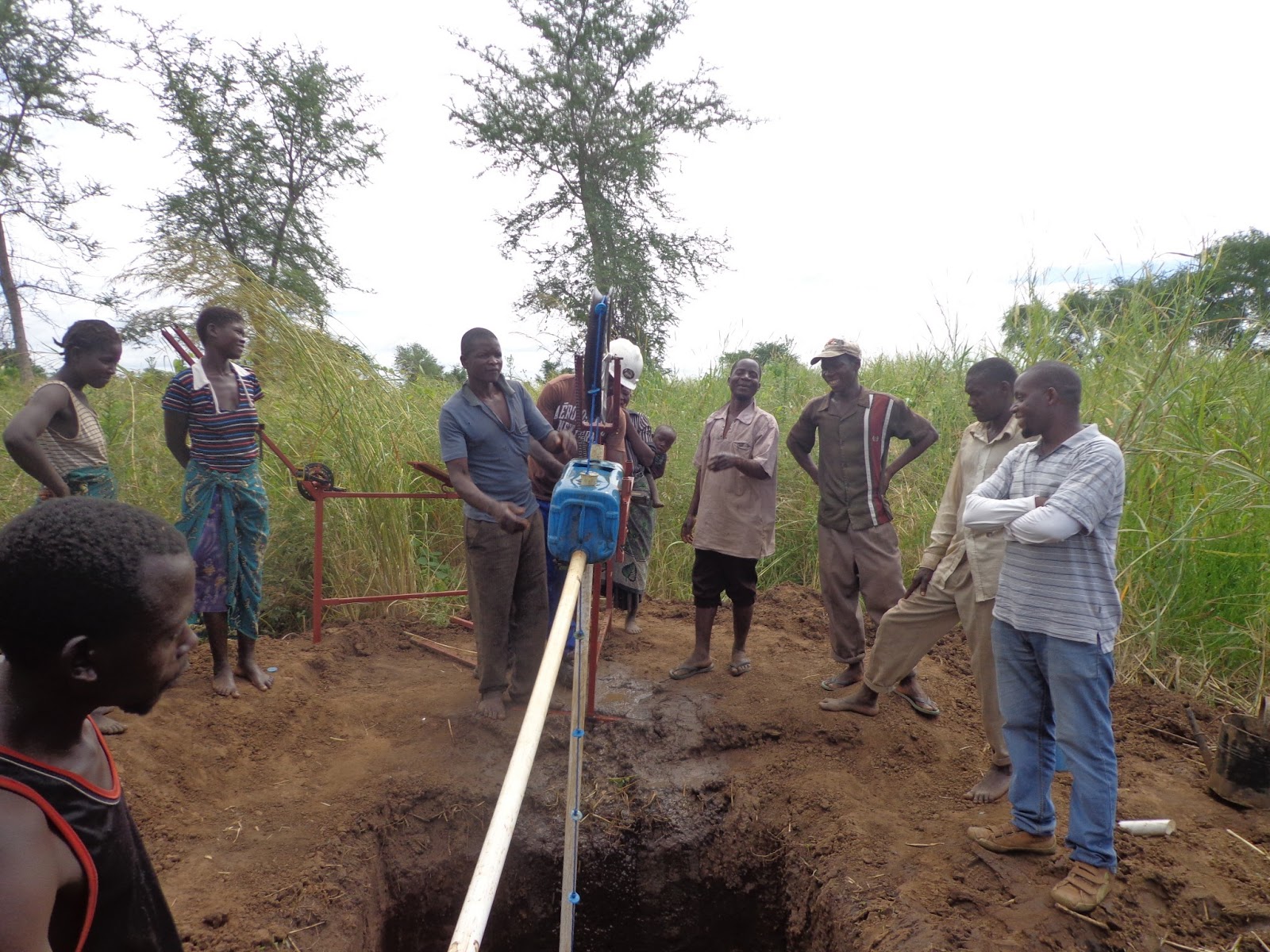
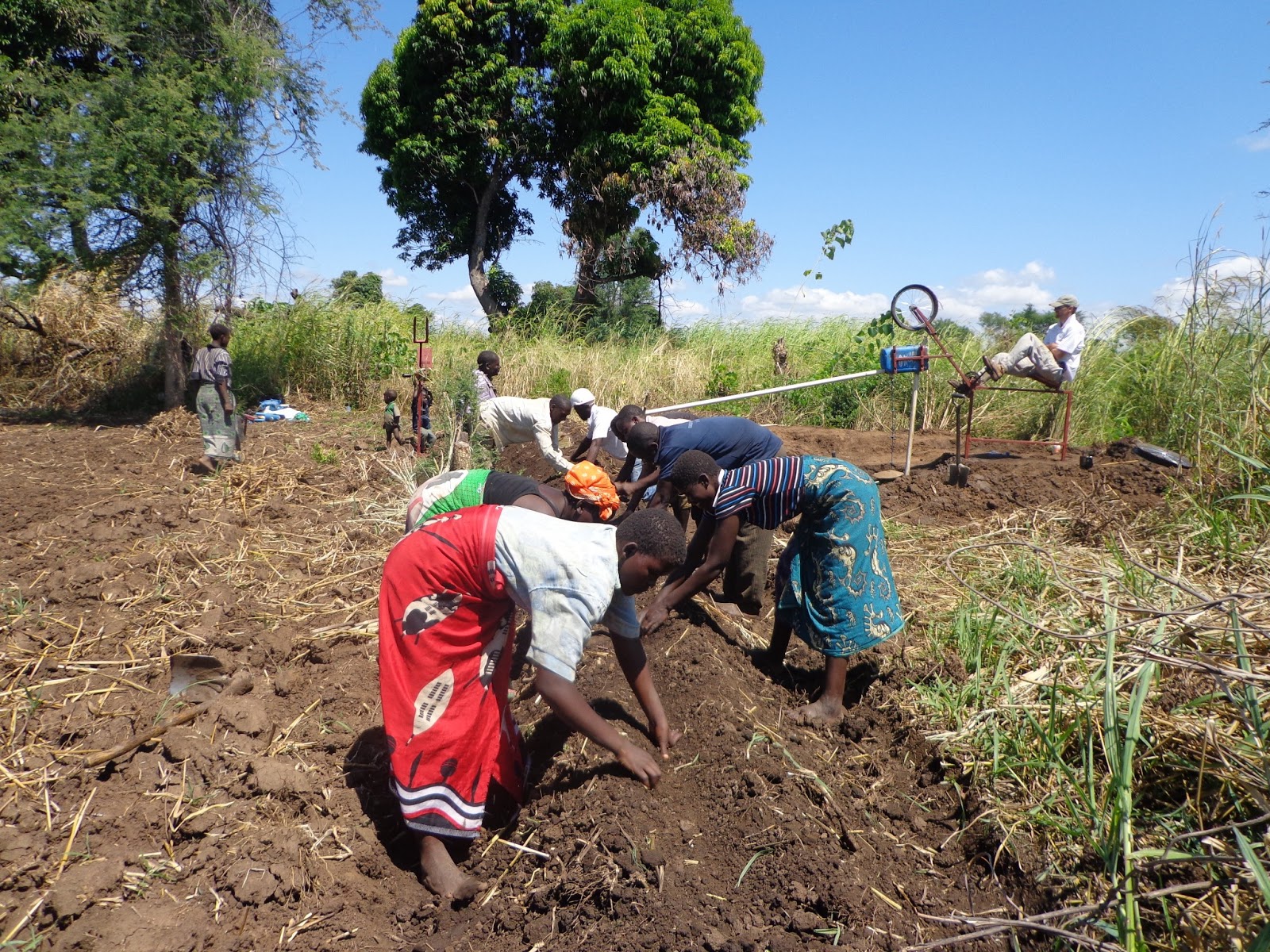
Second generation windmill at Mziza Demo Garden. We installed the windmill last week, letting it run over the weekend to check for any kinks. We hooked on the pumping rod today and a makeshift pump to see if we could get water into the tank. We did get water all the way to the tank, 3m above and 20m laterally from the water source.
Showing posts with label partner. Show all posts
Monday, September 9, 2013
Tuesday, July 9, 2013
New Irrigation Sites with NAPHAM
The National Association for People living with HIV and AIDS in Malawi (NAPHAM) is an organization established in Malawi to look into the needs of people affected by Human Immunodeficiency Virus (HIV) and Acquired Immune Deficiency Syndrome (AIDS). NAPHAM engage in advocacy campaigns, testing and counseling, education, and livelihood development. With over 1,000 support groups throughout the country, they reach out to tens of thousands of people to support their efforts to live positively even with the reality of HIV and AIDS in their communities and families.
Africa Windmill Project began training members of the Nathenje support group under a NAPHAM project aimed at developing nutritious and income-generating gardens. With such a great potential to improve the well being of their members, NAPHAM has decided to send the project into another community. This is the second phase of a long process of bringing irrigation training to thousands of their members across the country, people who generally struggle with insufficient nutrition.
At the Likuni support group outside Lilongwe, we saw relatively good irrigation activities already taking place. Using watering cans, most farmers are growing small plots of tomatoes and greens. It is our hope that with better water pumps and training, these farmers will be able to scale up to larger fields and diversify their crops.
AWP will return on Friday the 12th of July to begin the training process.
Africa Windmill Project began training members of the Nathenje support group under a NAPHAM project aimed at developing nutritious and income-generating gardens. With such a great potential to improve the well being of their members, NAPHAM has decided to send the project into another community. This is the second phase of a long process of bringing irrigation training to thousands of their members across the country, people who generally struggle with insufficient nutrition.
At the Likuni support group outside Lilongwe, we saw relatively good irrigation activities already taking place. Using watering cans, most farmers are growing small plots of tomatoes and greens. It is our hope that with better water pumps and training, these farmers will be able to scale up to larger fields and diversify their crops.
AWP will return on Friday the 12th of July to begin the training process.
Thursday, April 25, 2013
Siyasiya irrigation training
Last week, we went to Siyasiya in Salima to train farmers in basin irrigation. We were invited by World Relief international who support Ministry Teams from local churches in development and relief projects in the area.
The group picked up the ideas and techniques quickly and had a quarter acre ready for planting by the time we left. Over the next two weeks they will expand their garden up to 2-3 acres, where they will grow onions, tomatoes, maize and green vegetables.
Friday, February 1, 2013
Fly on the Wall
If you were a fly on the wall at the AWP office today, you would be the fly most equipped to provide high-impact irrigation training in probably the whole of Malawi, even in all of Africa. Maybe you'd be the best six legged irrigation trainer in the WORLD!
Ok, not many irrigation experts to compare in the insect family, but if you were a human on the wall at AWP (get off the wall and have chair), I hope you and the rest of the staff present today would be ready to deliver some outstanding training sessions to farmers in the field.
Teaching a group of adults whose ages range over 40 years, who may or may not be able to read, who usually have heavy burdens put on hold outside the classroom, teaching such a group is no easy task. And you just try for ten minutes to focus with an empty stomach... no, didn't think so.
After a few hours spent discussing how our training programme should adapt to the particular challenges we face in the field, we came up with a short protocol to guide us.
- Adults can only be expected to learn 5 simple things a day. If we selfishly take all those things for irrigation, we still should only expect 5 learned outcomes. Some things aren't so simple, so fewer expected outcomes is better.
- Good teachers deliver their outcomes over multiple routes; we should bring the learned outcomes through a variety of components: verbal/aural, visual (photographic/text), tactile, and participatory. These should be highly memorable and form memory indicators or associations.
- The visual and tactile elements should be left in the hands of the trainees to review/repeat in the future.
- We should hit the key memory indicators once more at the end of the training session.
Monday, January 7, 2013
Guest Blogger Today
Guest Blogger Jessica Irvin from Defending the Fatherless guest blogs today. She and her family support Africa Windmill Project in many of ways.
As the 2012 Christmas season fades into another year of memories, I continue to be bothered by a brief, 6 or 7 second news clip that my husband and I saw late one night in early December.
By most accounts, it was a heart warming moment-the result of one women’s kindness to a child—a child she would never meet, but was thoughtful enough to consider. We’ve seen it played out before, probably participated in a similar activity at one time or another. And, please don’t misunderstand my point-this woman was doing nothing wrong-in fact she was doing everything right by our cultural standards and norms. Yet, the words that she spoke have stuck with me in a way that I can only describe as nails on a chalk board. It stopped me in my tracks.
The scene was of a jolly middle aged woman, hands full of shopping bags loaded with Christmas treasures, happily donating a gift to a child via a local charity who may otherwise not receive a gift on Christmas morning. The phrase that made my heart beat a little faster, “It feels good to give to a child in need.”
Seems harmless enough and it’s true. It does feel good to give to someone in “need.”
What got me is that we had just returned home a few weeks prior to viewing this clip with our little son from Ethiopia, once in “need” of a family and now forever in our arms.
I had just witnessed NEED beyond understanding. True need—like for the basics—for things like water that doesn’t cause illness, food that satisfies a hunger that has often been growing for days, clothing and shelter and access to basic medical care to treat diseases easily treated here that devastate whole nations across the world-need for the things that so many of us (myself included) so often take for granted.
I looked at my husband and said, “We think toys are a NEED in America.”
We bought (literally) into this myth somewhat as each of our children received a couple of new items this Christmas, and with the exception of the toothpaste in their stockings (and I suppose one could make a case for whether or not that is truly a need), none of the new items were necessary for their health, well being or physical development. None of the items sustained life or gave life. None of the items had the potential to impact families or even whole communities.
Just as the Father loves to give good gifts to his children, we too enjoy seeing the faces of our children light up when presented with a gift. I’m not trying to take away from that, but to instead call to our attention that others suffer when we chose to add to our excess instead of, as the bible commands, share with God’s people who are in need (Romans 12:13).
And there are so many around the world in true need of the most basic resources, with probably the most important of these being clean water.
When I return home from Africa, I’m always a bit shell shocked upon reentry. I always say it is harder to return home than to return to Africa. I catch myself thinking thoughts like, “the water I shower with is cleaner than what they have to drink” or “I wash my clothes (well, technically the machine does) in cleaner water than they have available for cooking” or “I simply turn on one of my six faucets and clean water pours out while they hike 6 miles a day to the nearest water source.” And, none of it can be reconciled in my head except if I am willing to do something to make a difference.
I have seen first hand how life changing access to clean water is for a child, a family, and for entire communities.
Africa Windmill Project (AWP) works along side the people of Malawi to equip them to make these changes available to them. By educating and supporting rural farmers on how to irrigate crops via simple and affordable water pumps, Malawians are able to work to feed and care for their families. AWP also works to educate and train the local people on how to maintain clean drinking water, sustainable agriculture practices, and community development-all with the focus of Malawians being self-sufficient and duplicating the model within their own country.
Now, that’s something to feel good about.
To learn more about or partner with AWP as they help empower the people of Malawi to meet their NEEDS, please visit Africa Windmill Project.
Give, and it will be given to you. A good measure, pressed down, shaken together and running over, will be poured into your lap. For with the measure you use, it will be measured to you." Luke 6:38
Subscribe to:
Posts (Atom)
.jpg)