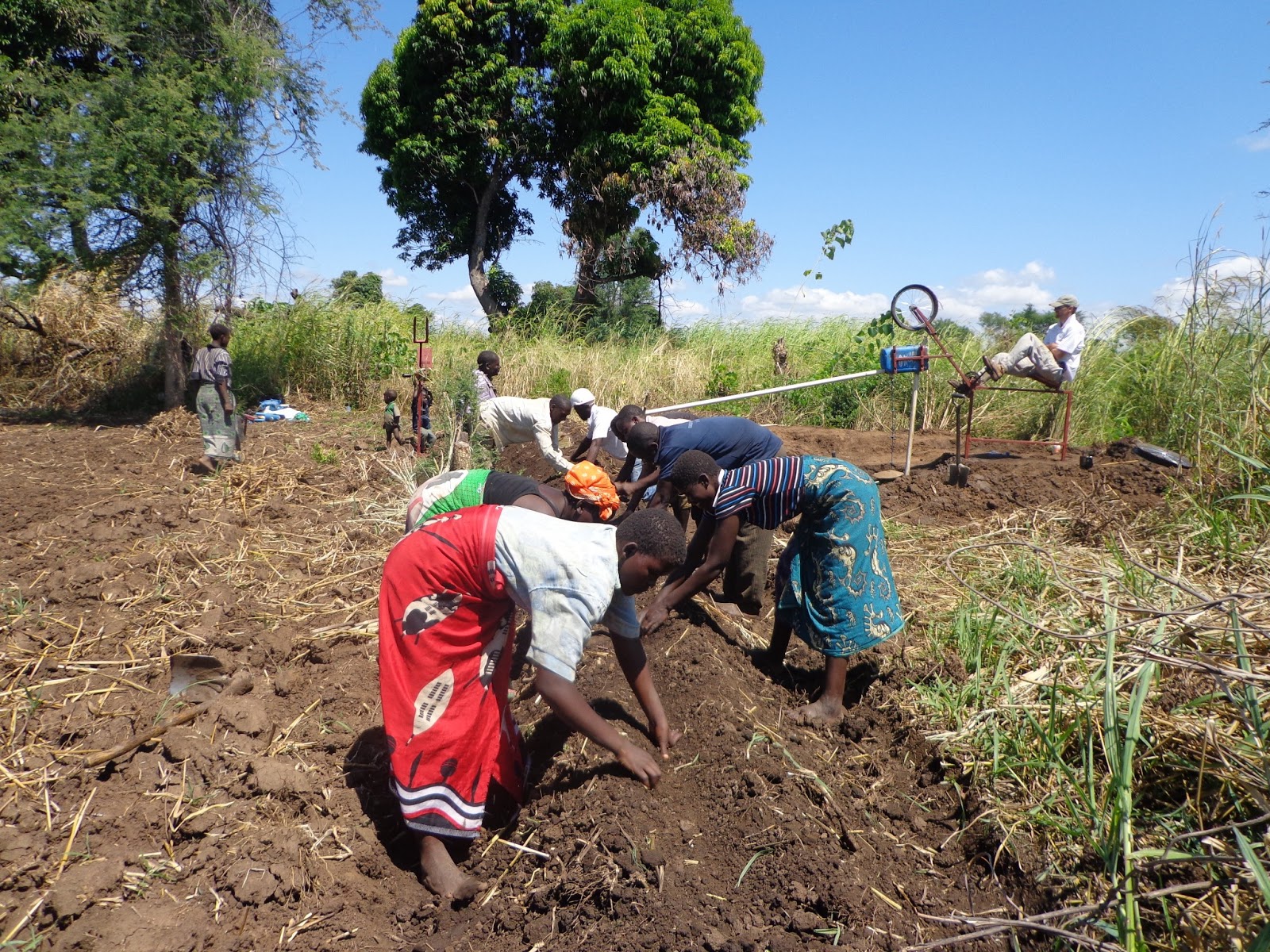
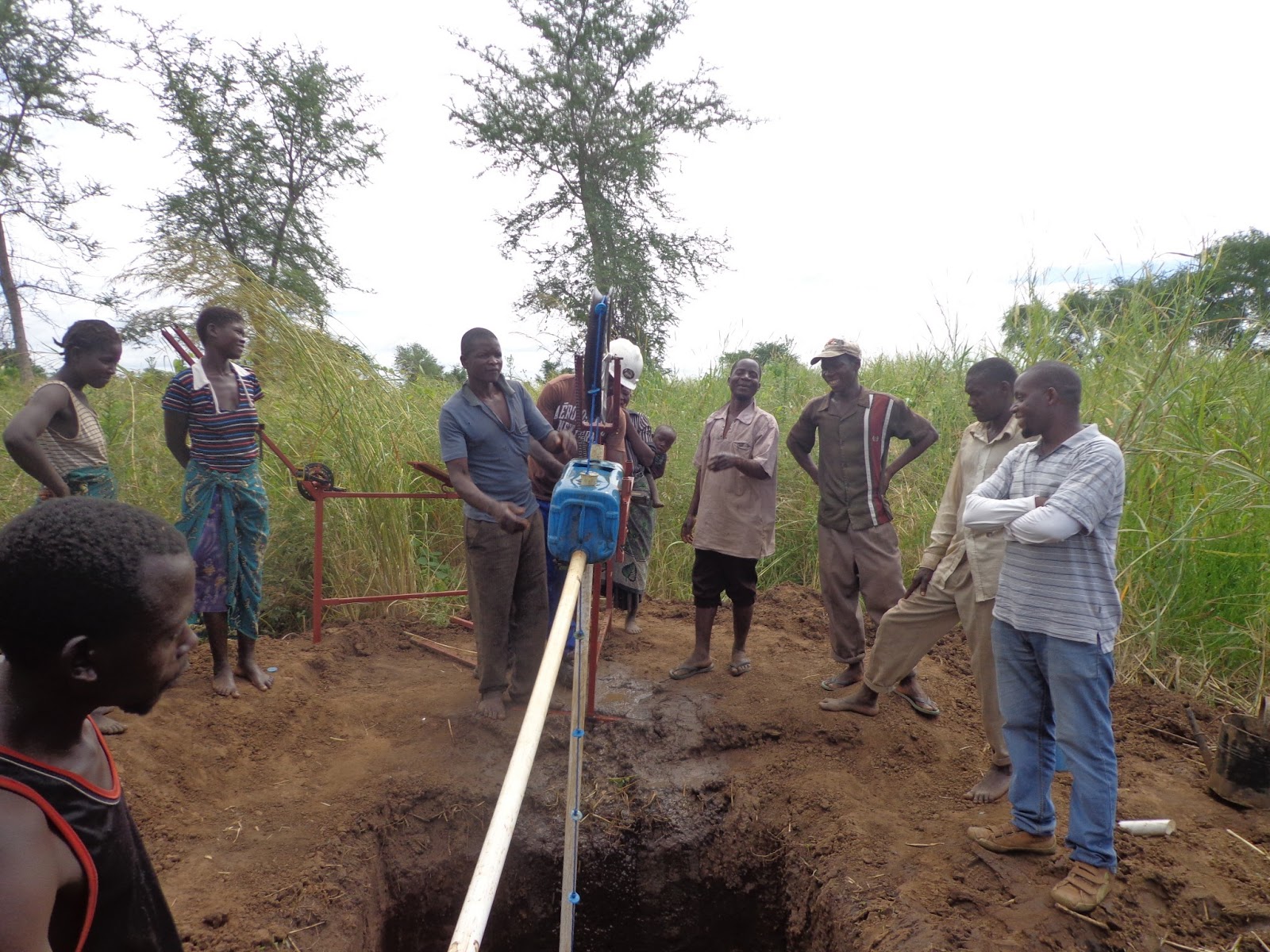
Second generation windmill at Mziza Demo Garden. We installed the windmill last week, letting it run over the weekend to check for any kinks. We hooked on the pumping rod today and a makeshift pump to see if we could get water into the tank. We did get water all the way to the tank, 3m above and 20m laterally from the water source.
Showing posts with label design. Show all posts
Monday, September 9, 2013
Saturday, August 24, 2013
Pedal pump
This is what our new pedal pumps look like. We incorporated more bicycle spare parts and the frame is all galvanized steel. It can be made by a bicycle repairman with off-the-shelf hardware.
Sunday, July 14, 2013
Likuni Irrigation underway!
On Friday we began the irrigation training process at NAPHAM's new site at Likuni in Lilongwe. The irrigation club was well prepared for us, having dug a new well and cleared the first section of their field.
First, we went through the initial set up of the pump, a maintenance overview, and how to use it.
Then we began digging the first feeder canal which will carry water to the beds where maize, tomatoes, and onions will be planted. In this training, there is no main canal, so water is fed directly into the feeder canal. As the garden expands, water will first enter a main canal, flowing laterally across the top of the garden, from where it will be diverted into feeders, and finally beds or basins.
For the next two days (Saturday and Monday) we will return to help them finish the digging of beds and to oversee the planting of maize. Within two weeks we expect to see maize emerging in the field and tomatoes and onions coming up in a nursery. At that point we will need to expand the garden to accommodate the tomatoes and onions.
First, we went through the initial set up of the pump, a maintenance overview, and how to use it.
Then we began digging the first feeder canal which will carry water to the beds where maize, tomatoes, and onions will be planted. In this training, there is no main canal, so water is fed directly into the feeder canal. As the garden expands, water will first enter a main canal, flowing laterally across the top of the garden, from where it will be diverted into feeders, and finally beds or basins.
For the next two days (Saturday and Monday) we will return to help them finish the digging of beds and to oversee the planting of maize. Within two weeks we expect to see maize emerging in the field and tomatoes and onions coming up in a nursery. At that point we will need to expand the garden to accommodate the tomatoes and onions.
Labels:
Africa,
agriculture,
compost,
conservation agriculture,
design,
Farming,
food,
health,
HIV,
hunger,
irrigation,
Maize,
Malawi,
NAPHAM
Tuesday, July 9, 2013
New Irrigation Sites with NAPHAM
The National Association for People living with HIV and AIDS in Malawi (NAPHAM) is an organization established in Malawi to look into the needs of people affected by Human Immunodeficiency Virus (HIV) and Acquired Immune Deficiency Syndrome (AIDS). NAPHAM engage in advocacy campaigns, testing and counseling, education, and livelihood development. With over 1,000 support groups throughout the country, they reach out to tens of thousands of people to support their efforts to live positively even with the reality of HIV and AIDS in their communities and families.
Africa Windmill Project began training members of the Nathenje support group under a NAPHAM project aimed at developing nutritious and income-generating gardens. With such a great potential to improve the well being of their members, NAPHAM has decided to send the project into another community. This is the second phase of a long process of bringing irrigation training to thousands of their members across the country, people who generally struggle with insufficient nutrition.
At the Likuni support group outside Lilongwe, we saw relatively good irrigation activities already taking place. Using watering cans, most farmers are growing small plots of tomatoes and greens. It is our hope that with better water pumps and training, these farmers will be able to scale up to larger fields and diversify their crops.
AWP will return on Friday the 12th of July to begin the training process.
Africa Windmill Project began training members of the Nathenje support group under a NAPHAM project aimed at developing nutritious and income-generating gardens. With such a great potential to improve the well being of their members, NAPHAM has decided to send the project into another community. This is the second phase of a long process of bringing irrigation training to thousands of their members across the country, people who generally struggle with insufficient nutrition.
At the Likuni support group outside Lilongwe, we saw relatively good irrigation activities already taking place. Using watering cans, most farmers are growing small plots of tomatoes and greens. It is our hope that with better water pumps and training, these farmers will be able to scale up to larger fields and diversify their crops.
AWP will return on Friday the 12th of July to begin the training process.
Tuesday, May 21, 2013
Katsumwa Irrigation: Up and Running
Irrigation is underway at Katsumwa Village, Lilongwe. There are five irrigation farmers using this system and 15 additional farmers participating in the training course, to eventually start their own irrigated gardens. Up to three acres of irrigable land sits within range of the water tank. For a start the farmers have cultivated about half and acre.
Due to the sandy soil the farmers had to dig a well farther from the water tank. In order to fill the tank over that distance we installed a 200 liter drum near the pump which is connected by ground pipes to the 13,000 liter tank. As the drum fills, the pressure in the drum exceed the pressure in the tank, and water begins to flow into the tank.
The water pump can usually pump faster than the water transfers from the drum to the tank, which could lead to an overflowing tank. However, this does not present a problem under normal conditions because the farmers take short breaks while pumping, allowing the drum and tank to equalize.
Water tank:
Distribution pipes:
Flow under minimum pressure:
Farmers learn pump maintenance:
Demonstrating how to direct water into the basins:
Demonstrating how to mulch the basins:
Due to the sandy soil the farmers had to dig a well farther from the water tank. In order to fill the tank over that distance we installed a 200 liter drum near the pump which is connected by ground pipes to the 13,000 liter tank. As the drum fills, the pressure in the drum exceed the pressure in the tank, and water begins to flow into the tank.
The water pump can usually pump faster than the water transfers from the drum to the tank, which could lead to an overflowing tank. However, this does not present a problem under normal conditions because the farmers take short breaks while pumping, allowing the drum and tank to equalize.
Water tank:
Distribution pipes:
Flow under minimum pressure:
Farmers learn pump maintenance:
Demonstrating how to water-in the basins:
Demonstrating how to direct water into the basins:
Demonstrating how to mulch the basins:
Tuesday, April 30, 2013
Wind Power!
Here is a brief look at some of the windmills we are working on this season:
Old Faithful: the AWP Demo Garden windmill has been pumping water into the reservoir since the end of last dry season. The windmill was disabled during the rainy season. Yesterday we hooked everything back up to mark the start of irrigation at the Demo.
Salima, a lakeshore district, is an exceptionally windy area. The potential for wind power is known by some local village residents. One such resident has constructed his own windmill not far from our Siyasiya irrigation site. When we venture into the area we always stop by his windmill to see what progress he has made. On our last trip we brought him some PVC turbine blades to improve the efficiency of his design. He was able to get some consistent voltage from the attached bicycle dynamo but not enough to light his house. As he refines the design, we will give him any advice and assistance we can.
More windmill to come as the
Thursday, April 25, 2013
Siyasiya irrigation training
Last week, we went to Siyasiya in Salima to train farmers in basin irrigation. We were invited by World Relief international who support Ministry Teams from local churches in development and relief projects in the area.
The group picked up the ideas and techniques quickly and had a quarter acre ready for planting by the time we left. Over the next two weeks they will expand their garden up to 2-3 acres, where they will grow onions, tomatoes, maize and green vegetables.
Tuesday, April 16, 2013
Getting Ready For Growth
The Mziza Farming Club is getting into irrigation as early as possible this season. On Monday this week, we delivered farm inputs which the farmers accessed through a revolving fund for input loans.
In order to access the loan, a farmer was required to participate in irrigation training and plant at least two season under the new irrigation techniques. Farmers who proved that they could be successful irrigation farmers could then apply to receive inputs to expand the size of their irrigated gardens.
Each member will pay back the loan over two consecutive planting cycles this season. In this way, the loss of capital incurred by paying back the loan is mitigated by the extra income of the second planting. In other words, with two planting cycles it is easier to balance the crop yield between: 1) paying back the loan, 2) eating a balanced diet at home, and 3) using income for other purposes (e.g. paying school fees).
Grass Mat Making at Mziza
Not just an outstanding lead farmer, our good friend Mr. Store is also an expert mat maker.
We stumbled upon his craft before a meeting with the Mziza Farming Club.
Saturday, March 2, 2013
Local Design Windmill
On the return journey of a recent field trip to irrigation sites in the Malawian lakeshore district Salima, we practically stumbled upon a local windmill. Tucked behind an acacia grove, so invisible to the many cyclists and motorists passing by, a recent high school graduate had been busy making his dream machine: a windmill generator/water pump.
He had heard we passed by on our way to the field and waited by the roadside four hours until we returned. Before we could get back on the tarmac and drive away oblivious to his invention, he flagged us down and directed us to his home and the 30' tower made from eucalyptus globulus (blue gum) poles.
While the unit did not generate electricity yet, he was preparing to mount a bicycle dynamo to the wheel. We gave him some pointers to help him understand what was happening. He could really understand the kind of power he was looking for and how his design might not work.
Before leaving we gave the best encouragement we could, don't give up, etc., (knowing that this kid probably didn't need any more encouragement than his own ambition). In the car again, we discussed what we could do to help. We came up with a few designs we could build in the workshop and bring back to show him next month. Of course we hope he will also have some improvements by then.
These gems are found throughout the world if only we could find them all!
He had heard we passed by on our way to the field and waited by the roadside four hours until we returned. Before we could get back on the tarmac and drive away oblivious to his invention, he flagged us down and directed us to his home and the 30' tower made from eucalyptus globulus (blue gum) poles.
While the unit did not generate electricity yet, he was preparing to mount a bicycle dynamo to the wheel. We gave him some pointers to help him understand what was happening. He could really understand the kind of power he was looking for and how his design might not work.
Before leaving we gave the best encouragement we could, don't give up, etc., (knowing that this kid probably didn't need any more encouragement than his own ambition). In the car again, we discussed what we could do to help. We came up with a few designs we could build in the workshop and bring back to show him next month. Of course we hope he will also have some improvements by then.
These gems are found throughout the world if only we could find them all!
Thursday, February 14, 2013
Siyasiya Irrigation Club
And finally, Siyasiya Village in Salima District. Yesterday we met the last group of irrigation farmers to be trained in 2013. Last but not least, this particular irrigation site is promising for the farmers and exciting for the AWP team.
First, just look at the turnout for the orientation meeting. The village was aware that only 15 farmers would be participating this year, but that did not seem to matter to the 60 or so others who showed up anyway.
The irrigation club was formed out of the Ministry Team of the local churches. The Ministry Team itself is a joint initiative of the churches and World Relief. In Salima district, World Relief has helped establish more than 20 similar ministry teams.
The AWP team knows how important good organization is for the success of community development projects, but having that organization as an extension of the local churches is more than we could have asked for, a true blessing.
The entire community have embraced the project and seem keen on diving into irrigation. We hope to deliver more than their expectations, a true blessing in return.
Tuesday, February 12, 2013
Mzindo Irrigation
It
had just stopped raining in Mzindo families run to the village
headman house to hold a meeting with him. The ten families remain
standing waiting for traditional leader to come out. He comes out,
and finds people with clothes dripping. One representative tells the
chief about the irrigation farming. The farmers did not know that AWP
had already met him to discuss irrigation farming in the area.
Later
that day, AWP starts off on the 30 km drive to Mzindo village to hold
the first meeting with farmers interested to participate in
irrigation farming. AWP finds farmers sitting around a big tree with
a big canopy that provides good shade to children, mothers, fathers
and the aged. During the day, most people would converge around these
trees to relax after working in the crop fields; play Bawo;
listen to cases; attend village meetings; watch traditional dances
like gule wamkulu and
any other traditional activity.
This
day, only adults sit around to hear what AWP has brought to the
village. Children play in the tall grass nearby. The meeting begins
with introductions and finishes with AWP telling farmers about
sustainable irrigation farming and the water pumps that would help
them to have improved crop yield each irrigation season. AWP asks the
farmers for their commitment to an irrigation project in the area.
This sends farmers into hand clapping and ululations.
One
farmer rises up and tells AWP how they have had problems using
watering cans to irrigate the crops; the activity of drawing water
alone is tiresome as compared to the irrigation technology they saw
in Mziza village, not far from their village. This farmer finishes by
saying the introduction of hand cranked and pedal pumps for
irrigation farming will help them to harvest more food in a year. The
farmers want to be the beginners in learning the new concept of
farming.
The
meeting ends with a visit to a new site where the village headman has
offered land for establishing an irrigation garden for other farmers
within and the neighboring villages.
Subscribe to:
Posts (Atom)
.jpg)