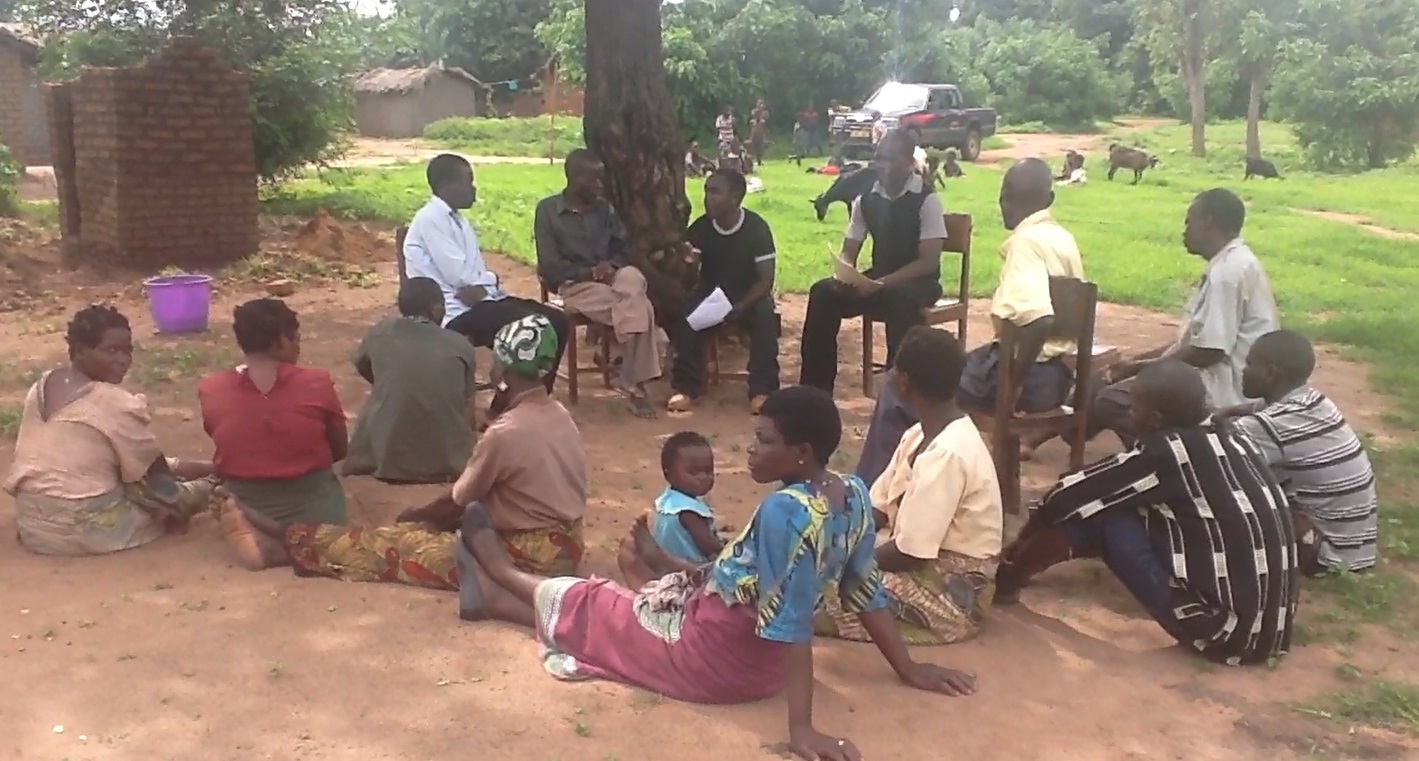
On Friday we began the irrigation training process at NAPHAM's new site at Likuni in Lilongwe. The irrigation club was well prepared for us, having dug a new well and cleared the first section of their field.
First, we went through the initial set up of the pump, a maintenance overview, and how to use it.
Then we began digging the first feeder canal which will carry water to the beds where maize, tomatoes, and onions will be planted. In this training, there is no main canal, so water is fed directly into the feeder canal. As the garden expands, water will first enter a main canal, flowing laterally across the top of the garden, from where it will be diverted into feeders, and finally beds or basins.
For the next two days (Saturday and Monday) we will return to help them finish the digging of beds and to oversee the planting of maize. Within two weeks we expect to see maize emerging in the field and tomatoes and onions coming up in a nursery. At that point we will need to expand the garden to accommodate the tomatoes and onions.
Showing posts with label HIV. Show all posts
Sunday, July 14, 2013
Tuesday, July 9, 2013
New Irrigation Sites with NAPHAM
The National Association for People living with HIV and AIDS in Malawi (NAPHAM) is an organization established in Malawi to look into the needs of people affected by Human Immunodeficiency Virus (HIV) and Acquired Immune Deficiency Syndrome (AIDS). NAPHAM engage in advocacy campaigns, testing and counseling, education, and livelihood development. With over 1,000 support groups throughout the country, they reach out to tens of thousands of people to support their efforts to live positively even with the reality of HIV and AIDS in their communities and families.
Africa Windmill Project began training members of the Nathenje support group under a NAPHAM project aimed at developing nutritious and income-generating gardens. With such a great potential to improve the well being of their members, NAPHAM has decided to send the project into another community. This is the second phase of a long process of bringing irrigation training to thousands of their members across the country, people who generally struggle with insufficient nutrition.
At the Likuni support group outside Lilongwe, we saw relatively good irrigation activities already taking place. Using watering cans, most farmers are growing small plots of tomatoes and greens. It is our hope that with better water pumps and training, these farmers will be able to scale up to larger fields and diversify their crops.
AWP will return on Friday the 12th of July to begin the training process.
Africa Windmill Project began training members of the Nathenje support group under a NAPHAM project aimed at developing nutritious and income-generating gardens. With such a great potential to improve the well being of their members, NAPHAM has decided to send the project into another community. This is the second phase of a long process of bringing irrigation training to thousands of their members across the country, people who generally struggle with insufficient nutrition.
At the Likuni support group outside Lilongwe, we saw relatively good irrigation activities already taking place. Using watering cans, most farmers are growing small plots of tomatoes and greens. It is our hope that with better water pumps and training, these farmers will be able to scale up to larger fields and diversify their crops.
AWP will return on Friday the 12th of July to begin the training process.
Monday, February 25, 2013
Monday, January 28, 2013
January Update
Hello Friends of AWP!
January has been spent kicking off a series of new projects in Malawi. As such, we need to kick off the Blog for the year too!
First, we want to thank everyone who has been reading the blog. I know that people read the blog for different reasons, and providing a variety of content is one of our goals this year. We want to showcase our work, provide technical details for those who land on this blog in search of pump/tech designs, and raise awareness for food security and other local issues.
We have spent this month meeting the farmers who will be in training this year.
At Nathenje: a 15 member support group organized by National Association for People living with HIV and AIDS in Malawi (NAPHAM).
Still to come: Katsumwa, Siyasiya and Kanyelele.
January has been spent kicking off a series of new projects in Malawi. As such, we need to kick off the Blog for the year too!
First, we want to thank everyone who has been reading the blog. I know that people read the blog for different reasons, and providing a variety of content is one of our goals this year. We want to showcase our work, provide technical details for those who land on this blog in search of pump/tech designs, and raise awareness for food security and other local issues.
We have spent this month meeting the farmers who will be in training this year.
At Nathenje: a 15 member support group organized by National Association for People living with HIV and AIDS in Malawi (NAPHAM).
At Mzindo: 5 families organized under AWP through outreach conducted by the Mziza Farming Club.
Still to come: Katsumwa, Siyasiya and Kanyelele.
Labels:
Africa,
agriculture,
AIDs,
Farming,
HIV,
irrigation,
teaching,
Villages
Sunday, September 2, 2012
The "Aha! moment"
In 7th grade I had a math teacher who said that rather than teach for the standardized tests, she teaches for the "Aha! moment". She was a good teacher, and we all learned a lot from her, about geometry and algebra, but the teaching philosophy most importantly. The "Aha! moment" is the moment when a person realizes they know what they are doing. In other words, the teacher may give us information, and we (lifelong students) may possess that information, but what is important is that we know that we know it.
And what signifies (to the teacher) that we have this knowledge? Some people exclaim "Aha!", but the surest sign is when the student corrects a teacher's mistake. It takes a good teacher to realize that being corrected by students is a good thing.
Some recent field days with farmers at Mziza have driven this point home.
What is causing the low water flow out of this pump?

AWP hypothesis: low rpm caused by bad gearing
Farmer's hypothesis: broken or bent washers caused by slack in the rope
Answer: improperly sized washers used to replace broken washers
One to the student... Of course, if we teachers had followed our own method, we should have come to the same hypothesis as the farmer.
What is causing low germination rate in this maize field?

AWP hypothesis: insufficient water
Farmer's hypothesis: mice
Answer: probably mice, as the problem ceased after burning out the mice holes.
Two lessons the teacher should take away from this:
1) follow your own method, and start with the simplest analysis.
2) local wisdom is exceptionally wise in its own locale; heed its advice.

Farmers are getting irrigation now. There is an intuitive understanding of how to use the water pumps, how to design and cultivate the garden, and how to plan their farming activities.

The next step, we hope, is that those who have excelled may start teaching others, first time irrigators and those who are struggling at some point in the process.
And what signifies (to the teacher) that we have this knowledge? Some people exclaim "Aha!", but the surest sign is when the student corrects a teacher's mistake. It takes a good teacher to realize that being corrected by students is a good thing.
Some recent field days with farmers at Mziza have driven this point home.
What is causing the low water flow out of this pump?
AWP hypothesis: low rpm caused by bad gearing
Farmer's hypothesis: broken or bent washers caused by slack in the rope
Answer: improperly sized washers used to replace broken washers
One to the student... Of course, if we teachers had followed our own method, we should have come to the same hypothesis as the farmer.
What is causing low germination rate in this maize field?
AWP hypothesis: insufficient water
Farmer's hypothesis: mice
Answer: probably mice, as the problem ceased after burning out the mice holes.
Two lessons the teacher should take away from this:
1) follow your own method, and start with the simplest analysis.
2) local wisdom is exceptionally wise in its own locale; heed its advice.
Farmers are getting irrigation now. There is an intuitive understanding of how to use the water pumps, how to design and cultivate the garden, and how to plan their farming activities.
The next step, we hope, is that those who have excelled may start teaching others, first time irrigators and those who are struggling at some point in the process.
Labels:
Africa,
Aha,
AIDs,
beekeeping,
compost,
conservation agriculture,
design,
Drinking Water,
ECHO,
Farming,
health,
HIV,
hunger,
irrigation,
Malawi,
philosophy,
rope and washer pump,
teaching,
windmill
Thursday, August 23, 2012
Keeping bees, diversifying income
Farmers we work with regularly live hand-to-mouth. Whatever they have, it's only enough for today, if even that. Tomorrow, they will go out to their fields to get some more food, they will go to the market to sell a handful of tomatoes to afford a bar of soap, or they will simply beg from a neighbour.
One thing that can help a farmer to get his head above water long enough to save and plan for the future is to diversify his income. A farmer who relies entirely on one small irrigated garden may produce enough food for his household, but what about school fees? Clothes? Medicine?
Africa Windmill Project is introducing bee keeping to the Mziza farming club. The club will share 5 beehives to start with, and expand later out of proceeds from selling honey. The benefits of beekeeping are threefold: first, there is the income from selling honey; second, the nutritional benefit of eating the honey; and third, the bees will help pollinate crops. Oh yes, and the farmers will be encourage to conserve their forests. And also, they may use the beeswax to make candles or soap. OK, so that was fivefold... and the benefits only get better as the farmers make more hives.
The club should bring enough money to purchase one new hive for each one they harvest. 5 become 10 become 20, 40, 80... within about 18 months. The limiting factor is of course space to hang them. This is where forest conservation becomes worth doing, so to speak. Without growing their forests, the farmers cannot grow their collection of hives.
Labels:
Africa,
AIDs,
apiculture,
beekeeping,
bees,
compost,
conservation agriculture,
ECHO,
Farming,
health,
HIV,
hunger,
irrigation,
Malawi,
Mziza,
need,
rope and washer pump,
Safe Water,
Solar,
windmill
Saturday, June 25, 2011
We Have A Truck!
Thank you everyone who contributed towards the truck! Africa Windmill Project now has a tuff 4x4 truck to continue conducting trainings in remote villages. Christopher and Blessings delivered supplies this past week for one complete windmill to the village of Mziza. Below are a few pictures of the action, thanks again for being a part of Africa Windmill Project.
Blessings is tying down the supplies.
Tuesday, April 5, 2011
Enabling families in the US to HELP families in Africa
A Truck.
Our current transport is pictured here. We call it the "goat" named because the horn is broken and sounds like a sick goat when used (which is often, because, well, it's Malawi).
We love the gas mileage this car gets, but used parts that we can find to fix it have about 10% of their life left. We have rebuilt and re-rebuilt this car. The villages we work in are not located on roads, speed bumps here in the US are nothing compared with the creeks, ditches and other obstacles that stand in our path when trying to reach our sites. Also, now that the farmers are seeing success they need to be able to take crops to market, which is more than a days walk in some cases.
When I asked Christopher if he would write a blog about this pressing need, this was his response...
"I will try to get a blog post up about the distance and conditions of the villages. I think one thing to remind the donors is that this will directly impact the people we are working with. Supplies will arrive on time and in 1 trip (rather then 5 or 6 different trips) and we will be able to search out new markets for their crops. Also the truck will help us in the future be able to reach villages farther from town that are neglected by support organizations and government programs"
So, if you are willing to donate money towards this need,
PLEASE go to www.africawindmill.org/donate.html or mail a check to Africa Windmill Project 2869 Carew Avenue, Winter Park, FL 32789 c/o John Drake (make all checks payable to Africa Windmill Project).
You will be directly impacting farmers and their childrens lives in Africa. Thank you for your generosity. We appreciate you!
Labels:
Africa,
AIDs,
conservation agriculture,
Farming,
HIV,
hunger,
irrigation,
Malawi,
need,
Villages,
water quality
Subscribe to:
Posts (Atom)