Showing posts with label need. Show all posts

Monday, January 7, 2013

Guest Blogger Today

Guest Blogger Jessica Irvin from Defending the Fatherless  guest blogs today.  She and her family support Africa Windmill Project in many of ways.


As the 2012 Christmas season fades into another year of memories, I continue to be bothered by a brief, 6 or 7 second news clip that my husband and I saw late one night in early December.
By most accounts, it was a heart warming moment-the result of one women’s kindness to a child—a child she would never meet, but was thoughtful enough to consider.  We’ve seen it played out before, probably participated in a similar activity at one time or another.  And, please don’t misunderstand my point-this woman was doing nothing wrong-in fact she was doing everything right by our cultural standards and norms. Yet, the words that she spoke have stuck with me in a way that I can only describe as nails on a chalk board.  It stopped me in my tracks.
The scene was of a jolly middle aged woman, hands full of shopping bags loaded with Christmas treasures, happily donating a gift to a child via a local charity who may otherwise not receive a gift on Christmas morning.  The phrase that made my heart beat a little faster, “It feels good to give to a child in need.”
Seems harmless enough and it’s true.  It does feel good to give to someone in “need.” 
What got me is that we had just returned home a few weeks prior to viewing this clip with our little son from Ethiopia, once in “need” of a family and now forever in our arms.  
I had just witnessed NEED beyond understanding.  True need—like for the basics—for things like water that doesn’t cause illness, food that satisfies a hunger that has often been growing for days, clothing and shelter and access to basic medical care to treat diseases easily treated here that devastate whole nations across the world-need for the things that so many of us (myself included) so often take for granted.
I looked at my husband and said, “We think toys are a NEED in America.”
And it broke my heart.  


We bought (literally) into this myth somewhat as each of our children received a couple of new items this Christmas, and with the exception of the toothpaste in their stockings (and I suppose one could make a case for whether or not that is truly a need), none of the new items were necessary for their health, well being or physical development.  None of the items sustained life or gave life.  None of the items had the potential to impact families or even whole communities.
Just as the Father loves to give good gifts to his children, we too enjoy seeing the faces of our children light up when presented with a gift.  I’m not trying to take away from that, but to instead call to our attention that others suffer when we chose to add to our excess instead of, as the bible commands, share with God’s people who are in need (Romans 12:13). 
And there are so many around the world in true need of the most basic resources, with probably the most important of these being clean water.


When I return home from Africa, I’m always a bit shell shocked upon reentry.  I always say it is harder to return home than to return to Africa.  I catch myself thinking thoughts like, “the water I shower with is cleaner than what they have to drink” or “I wash my clothes (well, technically the machine does) in cleaner water than they have available for cooking” or “I simply turn on one of my six faucets and clean water pours out while they hike 6 miles a day to the nearest water source.”  And, none of it can be reconciled in my head except if I am willing to do something to make a difference.
I have seen first hand how life changing access to clean water is for a child, a family, and for entire communities. 
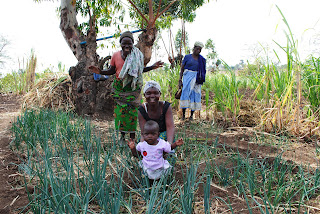

Africa Windmill Project (AWP) works along side the people of Malawi to equip them to make these changes available to them. By educating and supporting rural farmers on how to irrigate crops via simple and affordable water pumps, Malawians are able to work to feed and care for their families.  AWP also works to educate and train the local people on how to maintain clean drinking water, sustainable agriculture practices, and community development-all with the focus of Malawians being self-sufficient and duplicating the model within their own country.


Now, that’s something to feel good about.
To learn more about or partner with AWP as they help empower the people of Malawi to meet their NEEDS, please visit Africa Windmill Project.
Give, and it will be given to you. A good measure, pressed down, shaken together and running over, will be poured into your lap. For with the measure you use, it will be measured to you." Luke 6:38

Thursday, August 23, 2012

Keeping bees, diversifying income


Farmers we work with regularly live hand-to-mouth. Whatever they have, it's only enough for today, if even that. Tomorrow, they will go out to their fields to get some more food, they will go to the market to sell a handful of tomatoes to afford a bar of soap, or they will simply beg from a neighbour.

One thing that can help a farmer to get his head above water long enough to save and plan for the future is to diversify his income. A farmer who relies entirely on one small irrigated garden may produce enough food for his household, but what about school fees? Clothes? Medicine?

Africa Windmill Project is introducing bee keeping to the Mziza farming club. The club will share 5 beehives to start with, and expand later out of proceeds from selling honey. The benefits of beekeeping are threefold: first, there is the income from selling honey; second, the nutritional benefit of eating the honey; and third, the bees will help pollinate crops. Oh yes, and the farmers will be encourage to conserve their forests. And also, they may use the beeswax to make candles or soap. OK, so that was fivefold... and the benefits only get better as the farmers make more hives.

Mziza club members received their first hives on Tuesday. They had never seen the Kenyan Top Bar hive design, and thought it looked a lot better than their traditional hives, which consist of an overturned clay pot. They quickly went around hanging the hives in various strategic locations.

At the same time, AWP staff members were teaching them about how to monitor the hives for pests and overflowing honey.


The club should bring enough money to purchase one new hive for each one they harvest. 5 become 10 become 20, 40, 80... within about 18 months. The limiting factor is of course space to hang them. This is where forest conservation becomes worth doing, so to speak. Without growing their forests, the farmers cannot grow their collection of hives.


Thursday, November 3, 2011

AWP Manual/Pedal Water Pump

This is Post No. 1 in a series of 5; each post deals with the particulars of our projects. These posts are designed to give more information about the technologies and techniques AWP is promoting.

1. AWP Manual/Pedal Water Pump
2. AWP Windmill Water Pump
3. Basin Irrigation
4. Conservation Techniques
5. Solar Water Heater
                                                                                                                   
1. AWP Manual/Pedal Water Pump

Africa Windmill Project has the goal to bring sustainable irrigation systems to the hands of smallholders, farmers who wish to irrigate 1.0Ha (2.5 acres) or less.

The first development towards this goal is moving from watering cans to a positive displacement pump. The water pump that AWP promotes is a rope-and-washer pump operated by hand or foot. 


As the user rotates the crank (hand crank in the first two photos or bicycle crank in the third photo above), the tyre-pulley spins. The rope is pulled by the tyre-pulley, through the pipe (40mm diameter), down into the water, and back up the pipe. As the washers tied along the rope pass through the water, they lift water up and out of the pipe. This happens many times per second, and a large volume of water flows through the pump. Water flowing from the pipe falls into a 25 liter plastic container, which funnels the water into a larger diameter (50mm to 63mm). Finally, the water exits the pump into a stilling basin at the top of the irrigated garden.

The manual/pedal pump is very effective and can irrigation a substantial garden. Compared to a treadle pump, the manual/pedal pump is superior by every measure.

The cost of the pump is within range of most smallholders and can be earned back in one growing season. Farmers can be trained to build and maintain the pumps themselves, so there is little need for skilled technicians to install or repair pumps. Materials for the pump can be found and purchased in any district of Malawi.

For more information contact Africa Windmill Project through our website: CONTACT US.

Wednesday, October 5, 2011

Farmer Without the Use of His Legs Impresses Africa Windmill Project

When you read this story, you will find yourself wanting to visit Paul Ng’ondola of Mchera village, traditional authority Kaluma, in Ntchisi district. This man has a great garden to look at, a good house to admire in his village, and an amazing story to hear. Mr. Ng’ondola was born,48 years ago, without the use of his legs.


But how did AWP came to know Mr. Ng’ondola? Blessings Malamba (AWP Employee) had read an article some time ago about a farmer who was crippled in the newspaper. He recognized the water pump he works with for irrigation could be operated by a person with these physical challenges. Blessings had been working on a new design, which places the controls close to the ground. Fortunately, Malawi Broadcasting Corporation – MBC – offered AWP the details of how to locate the farmer that had been profiled on television and in newspapers as one of the few 2010 Malawian achievers in agriculture.


On 30th September, the AWP team visited Mr. Ng’ondola. They found him working alone in the field under the heavy heat of the sun. Our first view of his garden made our jaws drop. We were impressed by what we saw.
Mr. Ng’ondola received a primary school education, but due to his physical condition he could not continue in school. He can read only Chichewa, the local language. He is welcoming and always smiling to his occasional visitors, who often include Social Welfare representatives and more recently television crews and their newsmen.

Mr. Ng’ondola was excited to share about the history of his garden.
“I started farming on my own in 2002. I wanted to prove to the surrounding community that disability is not inability. Like others who have the same physical disability, I would have been in town or other locations begging for money. But I wanted to do something for myself. Luckily enough, in 2004 European Union brought an Income Generating Activity in our area that involved small scale farmers.” As he was explaining, I was moved with this story. A man who cannot walk or run is able to do what able-bodied people are failing to do. I was wondering who taught him how to make basins for irrigation and he explained. “European Union taught us how to make the basins. As you can see, the beds are uniform and they run parallel to the feeder canal”

When I looked at the field, I was surprised. How did he manage to channel water into his garden? The garden is far from the valley: it is established at higher elevation than typical, bucket-irrigated gardens.


Pointing to the horizon, he explains: “The water you see running in the canal comes all the way from that area. Participants dug the river diversion which passed through every garden. Unfortunately, EU discontinued the project, but I have continued growing maize up to date”.

But Mr. Ng’ondola does have challenges, he explained further.
“Look, my garden is at the far end, and I can’t access enough water. I have to wait or come early in the morning to irrigate my crop. Secondly, I can’t afford to purchase enough fertilizer. I buy what I can afford after selling maize. … I can’t stop farming. Where will I get food and money if I cease coming to the field?” I agree by nodding my head.

Mr. Ng’ondola married in May, 2010 and he has a son. Unfortunately the time we were at his garden, his wife was not around for us to meet. But he told me that his wife has been so helpful in his life and helps him in the field.

When we explained that AWP would like to install the rope and washer pump so he could irrigate his garden anytime, he was trembling with excitement. “Honestly speaking I can say I’m a lucky man. I will make use of every piece of information that you will pass on to me. Tell me what should I do?” Mr. Ng’ondola asked. AWP staff explained that his relatives could dig a well at the edge of his garden and that AWP would come back to install the water pump made specifically so that he can operate it with his hands while sitting down.

Within 3 days, Mr. Ng’ondola had called us. He had dug the well with the help of his brother and was ready for the pump to be installed. Again, excitement poured through his voice. We can only imagine what this pump means to him. Keep checking in for updates on Mr. Paul Ng’ondola as he begins using his new water pump

Written By Chaswezi Z. Simwela

Wednesday, September 14, 2011

Water Delivery Structure: Canal Construction Training

A lot has changed in this farmer's garden. He is doing so well that we decided to call a training session to demonstrate the method of constructing a good delivery canal. This method involves a concrete-like soil that forms a very hard surface. With this soil the canal withstands some abuse, and infiltration is greatly reduced over mud or sand canals.

Project coordinator Blessings Malamba teaches farmers how to compact soil at the base of the canal

Mustard greens grow in the foreground, broccoli in the background, an irrigation canal at right
Plastic linings for the canals have been used in the past, but it is costly. This plastic canal lining is a good example so-called "inappropriate" technology. What makes it inappropriate is that the type of plastic that is readily available and affordable is no more effective than the alternative (concrete-like soil), which is cheaper and more readily available. Of course, high grade plastic would be more effective than the soil method, but it is not appropriate to our farmers.
Peas, green beans, tomato, and mustard greens are irrigated from the trench in this photo

A view of a bean field from the water pump
Appropriateness, in the technical sense, is one of the most critical measures of a technology when it comes to predicting the success or adoption rate of the technology. That goes even for the West, where expensive options may still be appropriate. A good example in the West is that all Humvees are outfitted with automatic transmissions. In spite of the loss in performance and increased maintenance costs, the automatic transmission is more appropriate to unskilled drivers.
Lovely tomato

So here we are, deciding how best to get water to the crops. We must take into account more than the crop water requirements and the flow rate of our pump. We must consider the skill, fitness, time availability, and experience of the farmer as well.


After the training on canal construction, the group rides back to the village in the AWP vehicle

Monday, September 12, 2011

Shoes!

Club members were rewarded with new working shoes, a gift to appreciate their efforts and to commend their achievements. These farmers were not bad farmers before we came along; no, they were bad believers in themselves. They lacked confidence that they could bring something to market that is new, valuable, or rare.

They have done that. And they'll do it again, in style!

Thanks to Light Feet Project from Grove church in Chandler, AZ, for their generous donation of new shoes.


Saturday, September 10, 2011

The Windmill


Today we turned on the windmill to begin filling the reservoir. We are very pleased with the performance we saw today. We'll return on Monday to get the results of from the weekend.

It's a beautiful structure rising out of nowhere on the edge of a dambo. Quite the sight to see!

The tank is fitted with an inflow pipe just above and overflow pipe. The overflow is directed back into the well to prevent excessive groundwater losses in the event that the tank is full and the farmer is not prepared to use any water.

Ideally, the farmer would begin irrigating before the tank overflows so as not to waste any wind energy cycling water through the tank.
 
Water flowing into the tank
Club members were all smiles seeing the pump fully operational. It isn't difficult to see its potential from this point, delighting even the skeptics in the group. The club intends to begin using the land around the tank as a community garden so that each farmer has an opportunity to learn how to irrigate from the tank.

Keep checking in next week to see the results!


Tuesday, September 6, 2011

Windmill Reservoir

With successful tests under our belts, we have stepped up our work on the windmill irrigation scheme at Mziza. We have come up with a reservoir system that will act as a buffer between the pumping and delivery structures.
Expected benefits are:


  1. Water is available on demand

  2. Water will be under pressure at the top of the delivery system (and at the bottom if we use pipes instead of canals)

  3. The volume of water pumped into the tank can be easily recorded

  4. Farmers will know exactly how much water they are applying to the field (with the exception of evaporation)
Downsides to this system are: the capital cost of the reservoir (i.e. cement ain't cheap); evaporation will be greater in the reservoir than in the well; standing water attracts mosquitoes (and watering at dusk may put farmers at risk of malaria). There is not much that can be done to reduce capital costs because structural integrity should not be compromised. A crack in the floor of a house does not affect the utility of the house; whereas a crack in the reservoir floor is catastrophic. Every insurance must be made that the concrete will not crack. As for evaporation and mosquitoes, a simple covering over the reservoir will reduce these problems significantly.