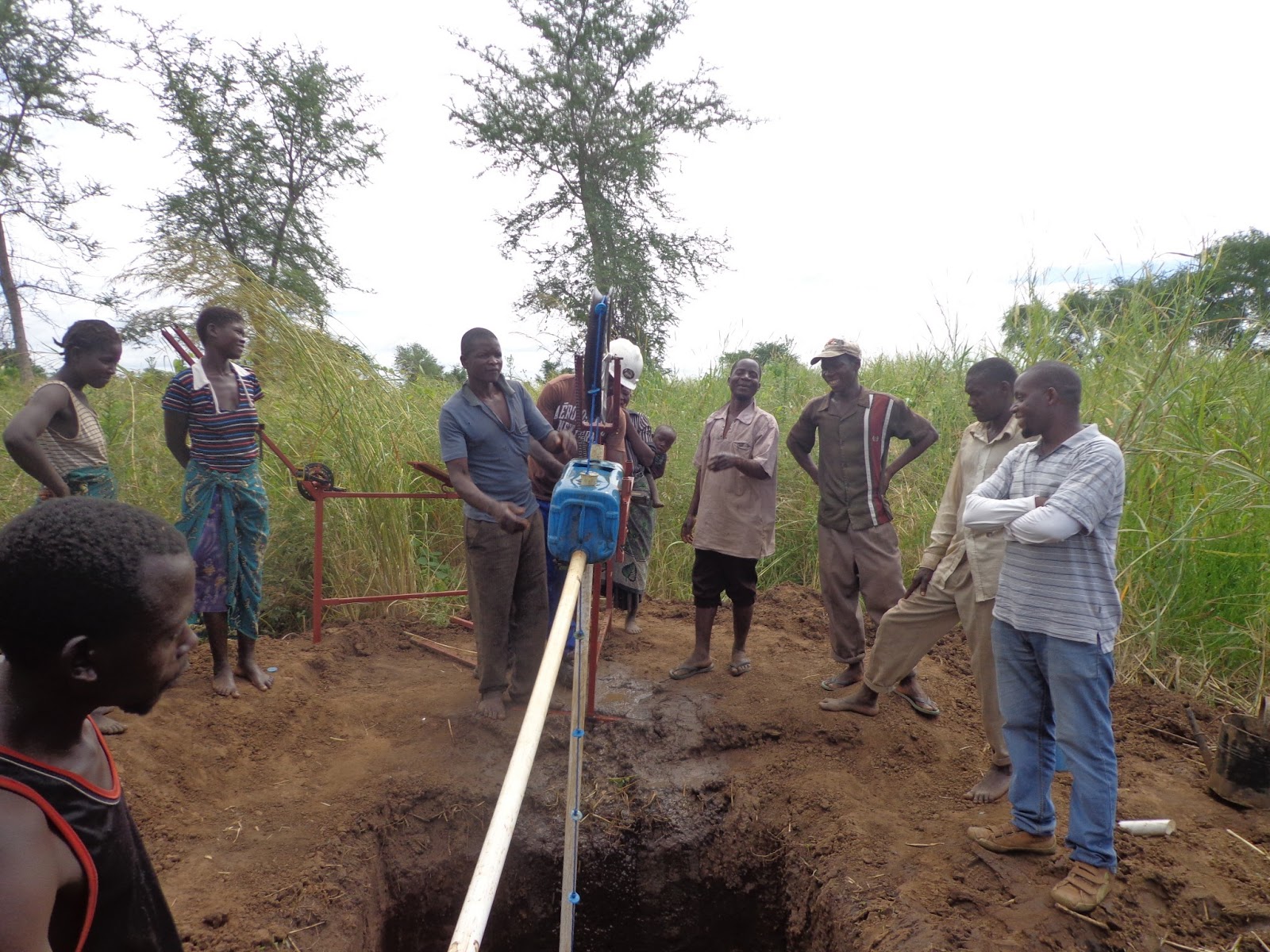
Second generation windmill at Mziza Demo Garden. We installed the windmill last week, letting it run over the weekend to check for any kinks. We hooked on the pumping rod today and a makeshift pump to see if we could get water into the tank. We did get water all the way to the tank, 3m above and 20m laterally from the water source.
Showing posts with label ECHO. Show all posts
Monday, September 9, 2013
Thursday, May 9, 2013
First Roots in the Ground at Siyasiya, Salima
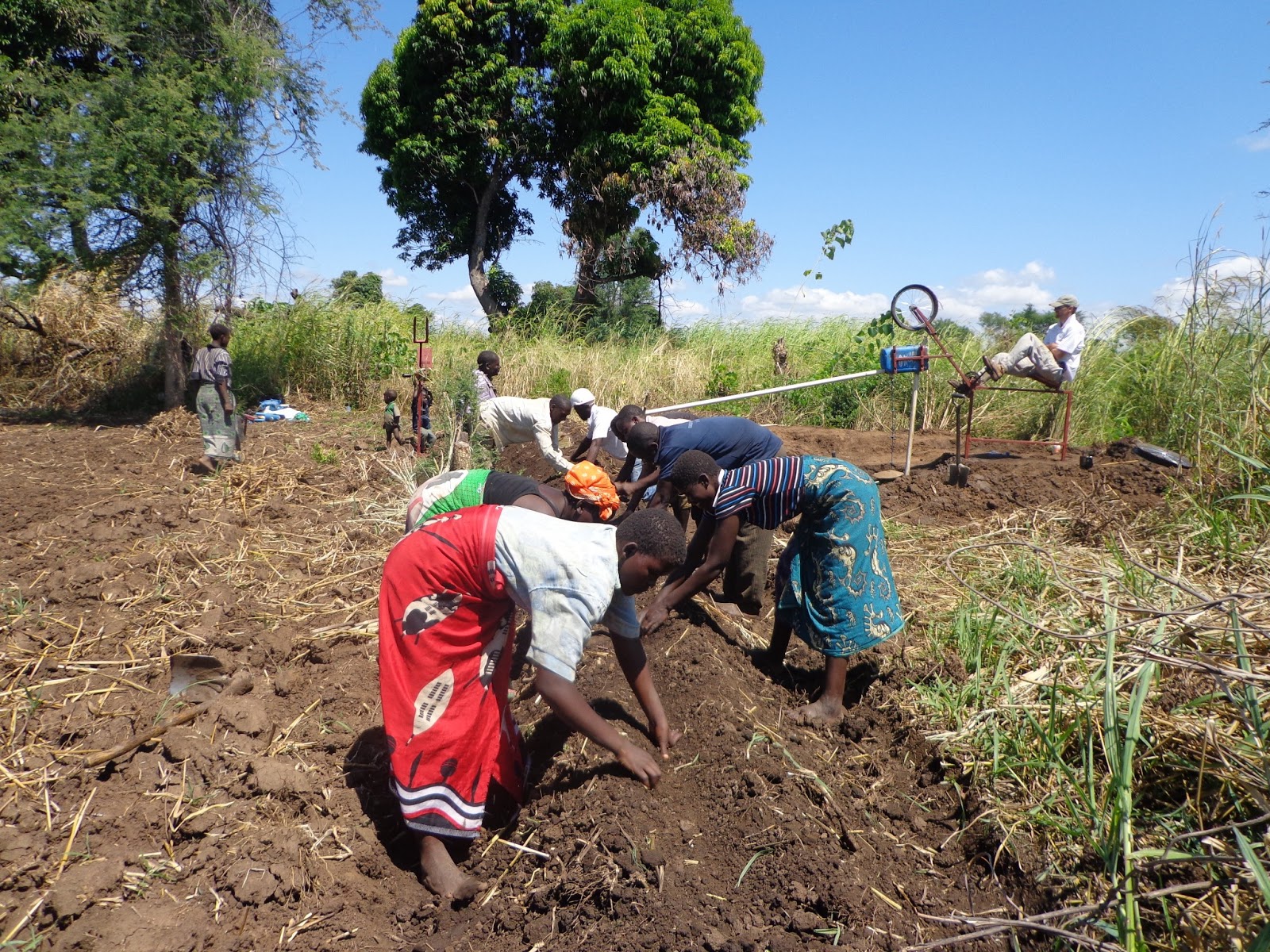
Farmers were busy in their irrigated gardens the past three weeks, putting to practice what they learned during the initial trainings in April. At Salima, the St. Barnabas irrigation club transplanted tomato seedlings into the first section of their garden.
Though they said they had some challenges at first, the irrigation process has not been difficult for them. They were excited to share with us their plans for expansion.
Labels:
Africa,
agriculture,
compost,
conservation agriculture,
ECHO,
Farming,
food,
health,
hunger,
irrigation,
Maize,
Malawi,
teaching,
Villages,
water
Thursday, April 25, 2013
Siyasiya irrigation training
Last week, we went to Siyasiya in Salima to train farmers in basin irrigation. We were invited by World Relief international who support Ministry Teams from local churches in development and relief projects in the area.
The group picked up the ideas and techniques quickly and had a quarter acre ready for planting by the time we left. Over the next two weeks they will expand their garden up to 2-3 acres, where they will grow onions, tomatoes, maize and green vegetables.
Monday, December 3, 2012
Irrigation Students at Natural Resources College
On the afternoon
of 26 November, the lecture theater at Natural Resources College
(NRC) was full with irrigation students and their lecturers awaiting
a presentation on irrigation technology by Africa Windmill Project
staff. The opportunity for the presentation came about after the
lecturers visited AWP irrigation demonstration garden and were
impressed with the irrigation technology.
NRC
offers various courses regarding natural resources and agriculture.
The irrigation course is relatively new to the college, having
started just a few years ago. With tight budgets and few hands-on
opportunities, students only get familiar with irrigation
technologies by visiting the much larger agricultural college, Bunda
College, or possibly by visiting Ministry of Irrigation sites within
a few kilometers radius.
AWP
shared with the students how the technologies are developed, the
amount of water they pump, the maximum effective acreage for each
pump, and the cost. Students gave feedback on the design and
implementation of the irrigation schemes. Among many good points,
they brought up the potential cultural challenges for women to use a
cycling pump. They suggested that we make a few changes that could
better accommodate the lady farmer.
At the
end of the presentation, the students had a chance to see a pedal
pump in action. The pump had to be set up without a well, which led
us to pump only a modest one meter of head. Nonetheless, the students
were able to ask questions and try out the pump, putting a practical
spin on the course material they have been studying.
We
hope that the students may have a chance to come out to our demo
garden next year to get their hands dirty with their fellow farmers
at Mziza.
Sunday, September 2, 2012
The "Aha! moment"
In 7th grade I had a math teacher who said that rather than teach for the standardized tests, she teaches for the "Aha! moment". She was a good teacher, and we all learned a lot from her, about geometry and algebra, but the teaching philosophy most importantly. The "Aha! moment" is the moment when a person realizes they know what they are doing. In other words, the teacher may give us information, and we (lifelong students) may possess that information, but what is important is that we know that we know it.
And what signifies (to the teacher) that we have this knowledge? Some people exclaim "Aha!", but the surest sign is when the student corrects a teacher's mistake. It takes a good teacher to realize that being corrected by students is a good thing.
Some recent field days with farmers at Mziza have driven this point home.
What is causing the low water flow out of this pump?

AWP hypothesis: low rpm caused by bad gearing
Farmer's hypothesis: broken or bent washers caused by slack in the rope
Answer: improperly sized washers used to replace broken washers
One to the student... Of course, if we teachers had followed our own method, we should have come to the same hypothesis as the farmer.
What is causing low germination rate in this maize field?

AWP hypothesis: insufficient water
Farmer's hypothesis: mice
Answer: probably mice, as the problem ceased after burning out the mice holes.
Two lessons the teacher should take away from this:
1) follow your own method, and start with the simplest analysis.
2) local wisdom is exceptionally wise in its own locale; heed its advice.

Farmers are getting irrigation now. There is an intuitive understanding of how to use the water pumps, how to design and cultivate the garden, and how to plan their farming activities.

The next step, we hope, is that those who have excelled may start teaching others, first time irrigators and those who are struggling at some point in the process.
And what signifies (to the teacher) that we have this knowledge? Some people exclaim "Aha!", but the surest sign is when the student corrects a teacher's mistake. It takes a good teacher to realize that being corrected by students is a good thing.
Some recent field days with farmers at Mziza have driven this point home.
What is causing the low water flow out of this pump?

AWP hypothesis: low rpm caused by bad gearing
Farmer's hypothesis: broken or bent washers caused by slack in the rope
Answer: improperly sized washers used to replace broken washers
One to the student... Of course, if we teachers had followed our own method, we should have come to the same hypothesis as the farmer.
What is causing low germination rate in this maize field?

AWP hypothesis: insufficient water
Farmer's hypothesis: mice
Answer: probably mice, as the problem ceased after burning out the mice holes.
Two lessons the teacher should take away from this:
1) follow your own method, and start with the simplest analysis.
2) local wisdom is exceptionally wise in its own locale; heed its advice.

Farmers are getting irrigation now. There is an intuitive understanding of how to use the water pumps, how to design and cultivate the garden, and how to plan their farming activities.

The next step, we hope, is that those who have excelled may start teaching others, first time irrigators and those who are struggling at some point in the process.
Labels:
Africa,
Aha,
AIDs,
beekeeping,
compost,
conservation agriculture,
design,
Drinking Water,
ECHO,
Farming,
health,
HIV,
hunger,
irrigation,
Malawi,
philosophy,
rope and washer pump,
teaching,
windmill
Thursday, August 23, 2012
Keeping bees, diversifying income
Farmers we work with regularly live hand-to-mouth. Whatever they have, it's only enough for today, if even that. Tomorrow, they will go out to their fields to get some more food, they will go to the market to sell a handful of tomatoes to afford a bar of soap, or they will simply beg from a neighbour.
One thing that can help a farmer to get his head above water long enough to save and plan for the future is to diversify his income. A farmer who relies entirely on one small irrigated garden may produce enough food for his household, but what about school fees? Clothes? Medicine?
Africa Windmill Project is introducing bee keeping to the Mziza farming club. The club will share 5 beehives to start with, and expand later out of proceeds from selling honey. The benefits of beekeeping are threefold: first, there is the income from selling honey; second, the nutritional benefit of eating the honey; and third, the bees will help pollinate crops. Oh yes, and the farmers will be encourage to conserve their forests. And also, they may use the beeswax to make candles or soap. OK, so that was fivefold... and the benefits only get better as the farmers make more hives.
The club should bring enough money to purchase one new hive for each one they harvest. 5 become 10 become 20, 40, 80... within about 18 months. The limiting factor is of course space to hang them. This is where forest conservation becomes worth doing, so to speak. Without growing their forests, the farmers cannot grow their collection of hives.
Labels:
Africa,
AIDs,
apiculture,
beekeeping,
bees,
compost,
conservation agriculture,
ECHO,
Farming,
health,
HIV,
hunger,
irrigation,
Malawi,
Mziza,
need,
rope and washer pump,
Safe Water,
Solar,
windmill
Saturday, September 10, 2011
The Windmill
It's a beautiful structure rising out of nowhere on the edge of a dambo. Quite the sight to see!
The tank is fitted with an inflow pipe just above and overflow pipe. The overflow is directed back into the well to prevent excessive groundwater losses in the event that the tank is full and the farmer is not prepared to use any water.
Ideally, the farmer would begin irrigating before the tank overflows so as not to waste any wind energy cycling water through the tank.
| Water flowing into the tank |
Keep checking in next week to see the results!
Tuesday, September 6, 2011
Windmill Reservoir
With successful tests under our belts, we have stepped up our work on the windmill irrigation scheme at Mziza. We have come up with a reservoir system that will act as a buffer between the pumping and delivery structures.


Expected benefits are:


Expected benefits are:
- Water is available on demand
- Water will be under pressure at the top of the delivery system (and at the bottom if we use pipes instead of canals)
- The volume of water pumped into the tank can be easily recorded
- Farmers will know exactly how much water they are applying to the field (with the exception of evaporation)
Subscribe to:
Posts (Atom)
.jpg)